
The Great Lie of the Internet Age: “We’re More Connected Than Ever”
All This Communication, and Still Nobody Feels Heard

We have more ways to communicate than any generation in history—and yet we keep misunderstanding each other, feeling lonelier, and calling it “normal.” Now that we have AI, I wonder, where can it help (without outsourcing your relationships)?
There’s a quiet contradiction baked into modern life:
We message constantly… and a lot of people still feel isolated, misunderstood, and emotionally far from the people they care about.
But people swear that we’re “more connected than ever.”
This isn’t just a mood. In May 2023, the U.S. Surgeon General released an advisory warning that loneliness and social isolation are a serious public health concern, with real consequences for mental and physical health—and called for rebuilding social connection at scale.
So how did we get here?
Because our communication changed faster than our communication skills did.
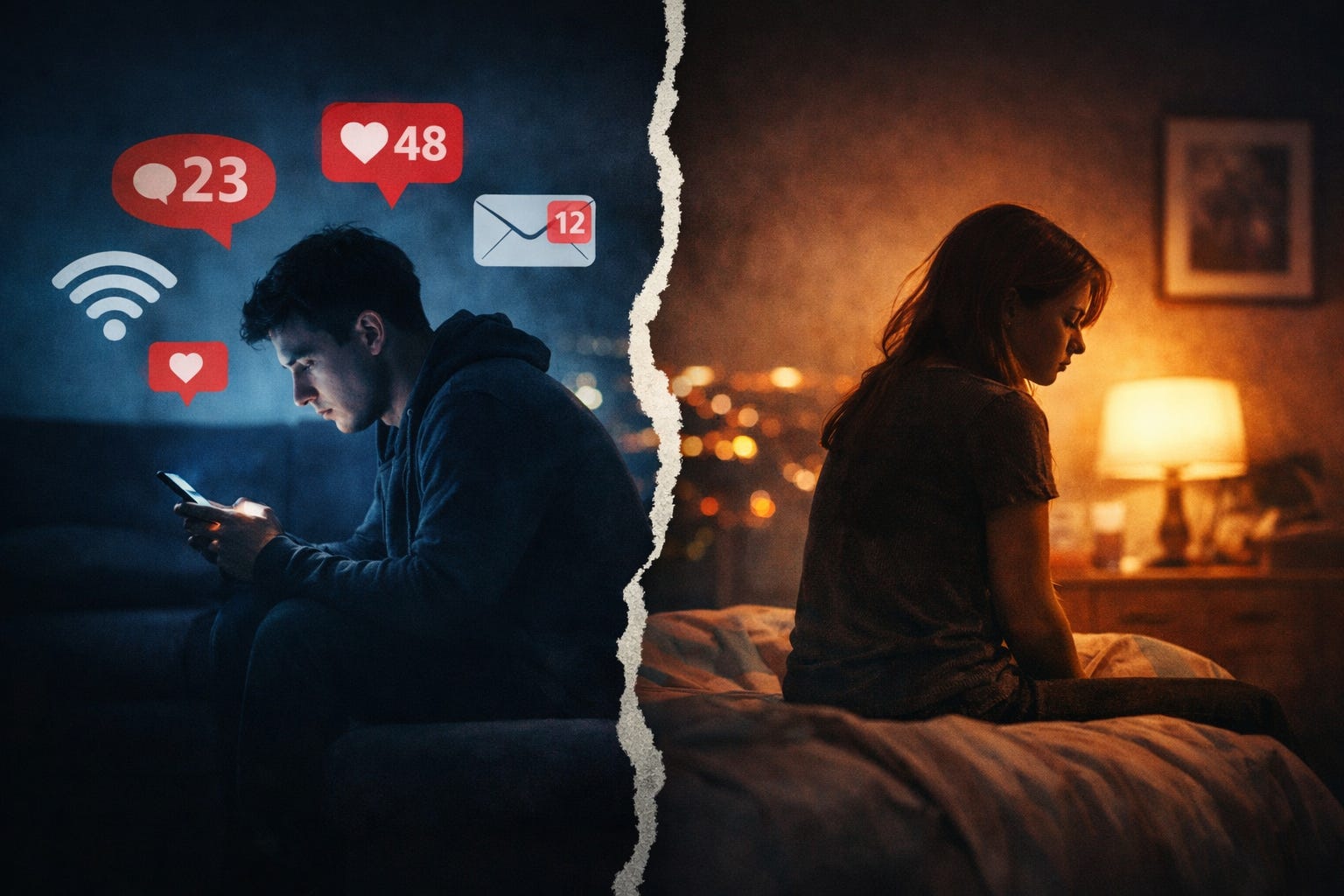
Why communication feels harder now
1) Most communication happens in low-cue environments
Text, DMs, email, Slack—convenient, fast, and tone-free in all the ways that matter.
When you remove facial expression, timing, vocal tone, and immediate feedback, misunderstandings don’t just become possible—they become predictable.
One classic finding: people routinely overestimate how clearly they communicate tone over email. Senders “hear” what they meant; readers just get words on a screen. In controlled studies, accuracy was much lower than people expected.
Translation:
Your “quick note” wasn’t quick. It was a misunderstanding with a timestamp.
2) Devices sabotage the “rich” conversations we still have
Even when you manage to talk face-to-face, the conversation can still be diluted by a tiny rectangle that screams, “This might get boring, so I brought an escape hatch.”
Research has found that the mere presence of a phone during a conversation can reduce perceived connection, trust, and empathy—especially when the topic is meaningful.
So yes, you were “together.”
But your attention wasn’t.
3) Social platforms reward reactive communication
Online spaces incentivize speed, certainty, and performative outrage—basically the exact opposite of what real relationships require.
Pew Research has documented how common “drama” and conflict are in teens’ social media experiences—and how often it shows up inside their peer relationships.
Adults aren’t immune. We just give it fancier labels:
“Work conflict”
“Family tension”
“Relationship issues”
“I’m just being honest” (a classic)
The skill gap: we’re losing practice in the basics
When communication becomes:
faster
more public
more text-based
more emotionally compressed
…we get less practice doing foundational human skills in real time:
naming emotions without dumping them
asking for what we need without demanding
disagreeing without dehumanizing
setting boundaries without cutting people off
repairing after tension instead of ghosting
This is one way detachment grows: not because people don’t care, but because they don’t know what to do next—so they avoid, escalate, or shut down.
And then everyone “moves on,” except nobody actually moved on.
Where AI can help society (when used responsibly)
Let’s be clear:
AI doesn’t solve loneliness. People do.
But AI can help with a more practical bottleneck: that moment when someone wants to communicate well, but doesn’t have the words, the strategy, or the emotional clarity.
Research on AI-mediated communication suggests it can measurably change how people write—often increasing speed/efficiency and making language more emotionally positive.
Other controlled work shows AI-assisted writing can affect trust-building dynamics (and raises real questions about authenticity and how people perceive AI-shaped messages).
Used well, tools like Pensy AI can function like training wheels for communication:
A pause button
Because “replying instantly” is not a virtue. It’s usually a symptom.
A clarity tool
“Wait—what am I actually trying to do here?”
repair?
be understood?
set a boundary?
get closure?
win? (be honest)
A perspective check
“How might this land on the other side?”
A draft partner
Turning messy emotion into a message that’s:
firm
calm
specific
human
A plan builder
“If they respond defensively, what’s my grounded follow-up?”
If more people had support in these moments—especially in families, workplaces, and schools—you’d likely see less unnecessary escalation and more repair.
The guardrails matter (a lot)
For AI to benefit society instead of weakening it, the goal can’t be outsourcing relationships.
It has to be building capacity.
Use AI to:
learn language you can eventually generate yourself
practice boundaries and repair (not passive aggression with better grammar)
choose better mediums (text vs call vs in-person)
reduce harm in high-emotion moments
Because the win isn’t perfect messaging.
The win is more people staying connected—on purpose—when it would be easier to detach.