
You’re Not Stuck. You’re Choosing To Stay
You’re avoiding the feelings that come with commitment because it is more comfortable to do nothing.

If you’re stuck in a relationship or a situation that’s slowly draining you, you already know.
Not in a dramatic, movie-montage way.
In a quiet, everyday way.
The way your chest tightens when their name pops up.
The way you rehearse conversations in the shower and then say nothing in real life.
The way you keep telling yourself, “It’s not that bad,” while your body votes yes it is.
And still… you stay.
Not because you lack information.
You’re not stuck because you’re unaware.
You’re stuck because information feels productive and commitment feels dangerous.
Information gives you the illusion of control.
Commitment forces you into consequences.
And consequences are the thing you’re actually afraid of.
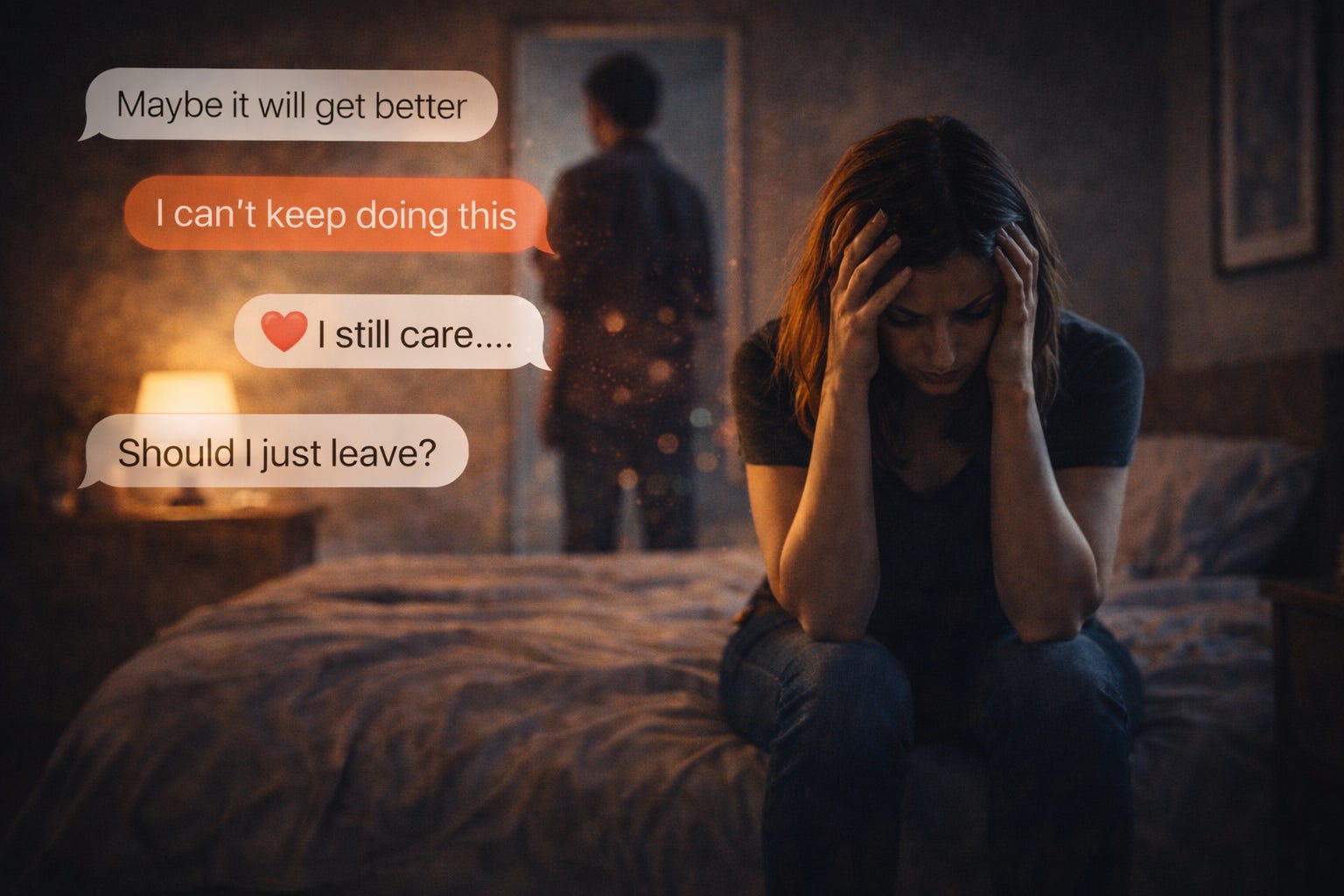
The modern relationship trap: “I’m working on it”
You don’t leave. You don’t confront it. You don’t set the boundary.
Instead, you become a scholar of your own unhappiness.
You:
watch relationship TikToks at 1 a.m.
save reels about “narcissists” and “attachment styles”
send memes to your friends like it’s a cry for help
read books on communication and emotional maturity
listen to podcasts titled something like “How to Know When It’s Time to Let Go”
And you tell yourself: “I’m working on it.”
Then the moment comes where you have to do the thing that changes your life:
“We need to talk.”
“I’m not okay with this anymore.”
“This isn’t working.”
“I’m leaving.”
“I need couples counseling or I’m done.”
“Stop speaking to me like that.”
“No.”
“I can’t keep carrying this alone.”
…and suddenly you need more clarity.
One more sign. One more month to “see how it goes.”
One more conversation that doesn’t actually say the thing.
That’s not growth.
That’s beautifully disguised procrastination.
And it’s very common—because it’s socially acceptable to be “processing” forever.
Why leaving feels harder than staying (even when staying hurts)
Here’s what people don’t like admitting:
You’re not choosing between pain and peace.
You’re choosing between familiar pain and unfamiliar pain.
Staying hurts, but it’s predictable:
You know how to survive the routine.
You know which version of them you’re getting most days.
You know how to walk on the eggshells.
You know how to make excuses for why it’s “complicated.”
Leaving (or changing the dynamic) introduces uncertainty:
What if I regret it?
What if I’m alone?
What if they spiral?
What if I’m the villain in their story?
What if I have to rebuild everything?
What if I’m wrong?
So you keep gathering information like it’s a shield.
Because learning about boundaries feels safer than setting one.
Ready isn’t a feeling
I’ve heard this a thousand times:
“I’m just not ready yet.”
Here’s the truth:
Ready is not a feeling. Ready is a decision you make before your emotions catch up.
If you wait until you feel ready, you’ll wait until the situation becomes unbearable.
And then you’ll call it “finally having clarity,” when really you just ran out of emotional credit.
The cost of staying shows up everywhere
Avoidance has a cost you are already paying.
You pay it in:
low-grade anxiety that never leaves (because unfinished truth lives in your body)
resentment (because you keep swallowing things you should be saying out loud)
confidence (because every promise you break to yourself teaches your brain not to trust you)
emotional numbness (because feeling less is easier than feeling the truth)
distance (because unspoken truth becomes loneliness inside a relationship)
And the wild part?
You can be in the same house, same bed, same life…
and still feel completely alone.
That’s not connection.
That’s coexisting.
If this sounds harsh, good.
You’re not fragile.
You’re probably tired of soft language that protects your ego while your life stays the same.
So here’s the practical part.
The One Decision That Breaks the Loop
Pick one decision you’ve been circling for at least 30 days.
Not ten decisions. One.
The one you keep revisiting.
The one your friends are tired of hearing about.
The one you keep “waiting for the right moment” to address.
Step 1: Write a deadline sentence
Write one sentence:
“By Friday at 5 PM, I will ______.”
Make it behavioral and visible.
Not:
“get clarity”
“think about it”
“work on communication”
“see how I feel”
But something you can prove happened:
“Schedule the conversation and put it on the calendar.”
“Tell them the boundary and what happens if it’s crossed.”
“Book a therapy session for myself.”
“Book couples counseling—or tell them I’m done if they refuse.”
“Call a friend and ask to stay with them Saturday night.”
“Consult a lawyer.”
“Look at apartments and tour one.”
“Move my paycheck to an account only I control.”
“Write the breakup message and read it out loud.”
You’re not deciding your whole life in one sentence.
You’re deciding the next real action.
Step 2: Lower the drama, raise the structure
Stop trying to “feel brave.”
Build pressure instead:
Put it on your calendar.
Tell one person who will ask for proof.
Remove one escape hatch.
Example escape hatches:
“I’ll wait until after their stressful week.”
“I’ll bring it up when they’re in a good mood.”
“I’ll do it after the trip.”
“I’ll do it after the holidays.”
“I’ll do it once I’m less emotional.”
Newsflash: there will always be a holiday, a trip, a stressful week, and a reason.
Step 3: Use the exact sentence (no improvising)
If you’re avoiding a conversation, don’t “wing it.”
That’s how people retreat.
Write the sentence you need.
Try this format:
“When ____ happens, I feel ____. I need ____. If it happens again, I will ____.”
It’s calm. It’s clear. It’s adult.
And it gives your nervous system rails.
The real question you’ve been avoiding
Stop asking, “What should I do?”
You already know.
Ask the only question that matters:
“What am I unwilling to feel in order to do it?”
Because the issue is rarely confusion.
It’s usually one of these feelings:
guilt (“I’ll hurt them.”)
fear (“What if I’m alone?”)
conflict (“They’ll explode.”)
shame (“I should’ve known better.”)
grief (“This is ending.”)
uncertainty (“I don’t know who I am after this.”)
You’re not stuck because you don’t know.
You’re stuck because you don’t want to feel that.
But here’s the deal:
You’re already feeling something.
It’s just stretched out over months.
So the question becomes:
Do you want short-term discomfort with long-term freedom…
or long-term discomfort with short-term familiarity?
A small challenge (do this today)
Pick one thing you’ve been delaying.
Write:
“By Friday at 5 PM, I will ______.”
Then tell one person who will ask you for proof.
Not for motivation. For accountability.
Because momentum isn’t magical. It’s mechanical:
Action creates evidence.
Evidence creates confidence.
Confidence makes the next action easier.
You don’t need a new identity.
You need one honest action.
One practical thing that helped me with this exact loop: create a 72-hour decision window.
1) Write the one boundary/decision in one sentence.
2) Schedule the conversation before the window closes.
3) Text one accountability person the exact time.
It keeps you from turning clarity into another research project. Small structure, big momentum.